
Reviewed · PRIVATE
Uyuni Salt Flats 4-days tour from Atacama> private room available
The main event is the Uyuni Salt Flats, where sunrise turns a vast white salt plain into one of South America’s most striking sights. But the road there matters just as much. You’ll cross the Andes, pass colored lagoons and flamingo habitat, soak in a high-altitude hot spring, and sleep in a hotel built from salt.
I like two things right away: the tour includes meals and accommodation, so you are not left arranging basic needs in remote Bolivia, and the seven-seater 4×4 keeps the group small enough for a more personal ride. The main caution is altitude. The first day is demanding, and one French-speaking participant found the effects much harder than expected.
In This Review
- Key points at a glance
- Why the route is more than a trip to Uyuni
- Day one: border crossing, geysers, and flamingos
- Polques Hot Springs and the Sol de la Mañana geysers
- Laguna Colorada and the first night in Villa Mar
- Day two: volcanic rock, black water, and highland wetlands
- Colcha K and a salt-built hotel
- Day three: sunrise at the Salar de Uyuni
- Incahuasi Island and the famous salt-flat photographs
- Lunch in Colchani and the Train Cemetery
- Day four: the long return to San Pedro
- What the $325 price really covers
- Guides, language, and the human side of the trip
- Altitude, cold, and the physical demands
- Who should book this four-day crossing?
- Should you book it?
- FAQ
- How long is the Uyuni Salt Flats tour from San Pedro de Atacama?
- Is hotel pickup included in San Pedro de Atacama?
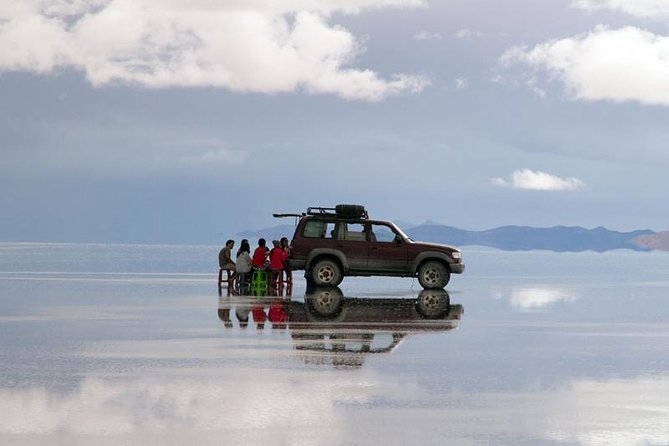
- What type of vehicle is used?
- Is accommodation included?
- Are meals included?
- Are entrance fees included?
- What language does the guide speak?
Key points at a glance
- A four-day crossing from Chile into Bolivia: Begin with hotel pickup in San Pedro de Atacama and finish back in town around 1:00 PM on day four.
- The scenery starts before Uyuni: Visit White Lagoon, Green Lagoon, Sol de la Mañana geysers, Laguna Colorada, and the Salvador Dali Desert.
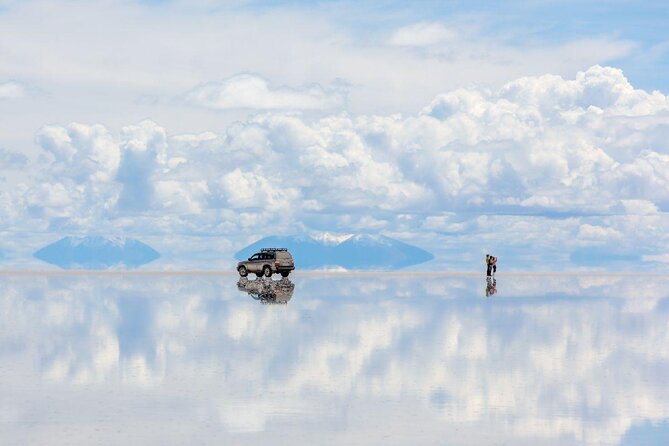
- The salt flats change with the season: January through March can bring the famous mirror effect, while the dry season offers crisp white salt and playful perspective photos.
- The group is capped at 12 people: You travel in a seven-seater 4×4 after crossing the border, with vehicles arranged for the full group.
- Private-room lodging may be available: Hostel accommodation is included, with private or shared dorm options depending on availability.
- Budget carefully for extra fees: Incahuasi Island, the hot springs, and national park entry are not included, and a Bolivian border tax may apply.
Why the route is more than a trip to Uyuni
Many people think of Uyuni as one giant white plain and little else. This route gives you a much fuller picture of the Bolivian Altiplano. You see volcanoes, mineral-colored water, steaming ground, dry rock formations, wetlands, flamingos, and abandoned railway equipment before reaching the salt.
That variety is the tour’s great strength. The trip is not simply a long transfer followed by a quick photo stop. You spend most of the first two days inside the Eduardo Avaroa National Andean Fauna Reserve, a remote high plateau where the scenery changes every hour.
It is also a demanding trip. You spend long stretches in the 4×4, rise before dawn twice, cross a national border, and sleep in basic hostel accommodation. I would choose it for the sense of place and the sheer variety, not for comfort or a relaxed schedule.
A few more San Pedro de Atacama trips to weigh up
- Full Atacama – SORBAC (private groups)
★ 5.0 · 76 reviews - San Pedro de Atacama: Private Dinner Under the Stars
★ 5.0 · 4 reviews - Private Santiago City Half Day Tour
★ 4.0 · 414 reviews
Day one: border crossing, geysers, and flamingos
Your day begins around 7:00 AM with pickup at your San Pedro accommodation. Once the group is collected, a shuttle takes you to the Bolivian border. You get your passport stamped and change into a seven-seater 4×4 for the main route.
That vehicle change matters. The shuttle handles the Chilean side and border transfer, while the 4×4 is suited to the rougher roads and remote stops in Bolivia. Since the group limit is 12, more than one vehicle may be used, but each 4×4 carries a small number of people.
The first major sights are White Lagoon and Green Lagoon beneath Licancabur Volcano. The colors come from minerals and other natural conditions, so the exact intensity can vary. Even so, the contrast between the water, volcanic peaks, and open high plateau gives you an immediate sense that this is not an ordinary road trip.
Next comes the Salvador Dali Desert, named for its strange, isolated rock shapes and wide, sandy setting. It is a good place to pause and take in the scale of the Altiplano. You will want warm layers here. The high plateau can feel cold, particularly when you are standing still for photographs.
Polques Hot Springs and the Sol de la Mañana geysers
The Polques Hot Springs offer one of the day’s best changes of pace. After several hours in a cold, dry region, sitting in natural thermal water feels wonderfully practical, not merely scenic. The hot spring stop lasts about two hours, including time to change and soak.
The provided information does not include the hot spring admission fee, so budget for it separately. Bring a swimsuit and keep your towel and dry clothing easy to reach. The difficult part, as you may expect, is getting out into the cold air.
After lunch near the hot springs, you continue to the Sol de la Mañana geyser field. This is not a polished geothermal park. You see fumaroles and small geysers in an open setting, with steam and the smell of sulfur adding to the sense of raw natural force.
The stop is scheduled for about two hours, and admission is included. Stay alert around the geothermal ground and follow your driver’s instructions. The attraction is the untamed setting, but that also means the area demands care.
Laguna Colorada and the first night in Villa Mar
By late afternoon, you reach Laguna Colorada, or Red Lagoon. The reddish water makes it the most instantly recognizable stop of the first day, and three flamingo species use the lagoon as nesting habitat.
You take a short walk along the edge rather than spending the entire afternoon hiking. That is welcome after a full day on the road, although altitude and cold can still make a short walk feel strenuous. Take your time, drink water, and do not treat the stop as a race for photographs.
Dinner and the first night are in Villa Mar. Three dinners, three lunches, and three breakfasts are included across the tour, which is a real advantage in such remote country. You do not need to plan every meal between border crossings and long drives.
The lodging is hostel-style. A private room may be available, but the standard accommodation can also be a shared dormitory, so confirm the room arrangement before booking if privacy matters to you. This is functional accommodation, not a resort stay.
Same long country, a very different day out:
- San Pedro de Atacama: El Tatio Geysers Tour
★ 4.7 · 943 reviews - San Pedro de Atacama: Etno-Stargazing Tour with Transfer
★ 4.8 · 629 reviews - Piedras Rojas, Altiplanics Lagoons & Salar Full-Day Tour
★ 4.7 · 592 reviews - San Pedro de Atacama: Stargazing Experience
★ 4.7 · 489 reviews
Day two: volcanic rock, black water, and highland wetlands
After breakfast, the route continues through geological formations known as Lost Italy and the Valley of Rocks. Erosion has shaped the volcanic rock into forms with names such as the Camel and the World Cup. These stops are ideal for photographs because the shapes are easy to frame against the open desert.
The route description lists about two hours for this section. It also repeats some of the wording for the following stop, so treat the schedule as a guide rather than a promise of exact minute-by-minute timing. Road conditions, photo stops, and the group’s pace can affect the day.
Laguna Negra, or Black Lagoon, follows. The dark water and stark surroundings create a sharp contrast with the bright salt and red water you see elsewhere. The stop is listed at about three hours, making it one of the longer pauses of the day.
You then reach Anaconda Canyon, where natural viewpoints look down on a winding river far below. The canyon gives you another change in scale. Instead of open plains, you get a narrow river corridor cut through the dry highlands.
The day also includes the Sora Wetland. This is one of the more useful stops for understanding the region’s variety. Birds, camelids, and plants adapted to the Altiplano gather around a wetter setting, offering a welcome break from the more barren rock and sand.
Colcha K and a salt-built hotel
On the return toward your accommodation, the route stops in the small village of Colcha K. There is a shop where you may sample local beers from the Bolivian Altiplano and connect to Wi-Fi.
Do not count on the Wi-Fi as a major communication solution, but it can be useful for sending a message or checking in. The local beer stop adds a modest connection with present-day life in the region, rather than keeping the trip focused only on natural sights.
At sunset, you head to a salt hotel. The rooms are built entirely from salt, creating one of the trip’s most unusual lodging experiences. You dine with views across the high plateau and sleep in a private room at this property.
This is the point where the private-room option matters most. You still need to confirm availability, but the itinerary specifically includes private rooms in the salt hotel. If you want this arrangement, ask before paying rather than assuming every booking receives it.
Day three: sunrise at the Salar de Uyuni
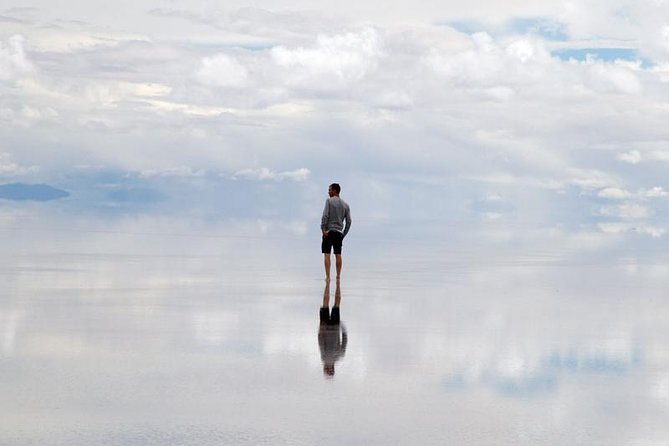
Day three begins at 5:00 AM. You eat breakfast at the accommodation, then set out for the Salar de Uyuni in time for sunrise.
The early start is not optional in spirit. The point is to reach the salt flats while the light is changing, when the huge white surface can take on soft colors and long shadows. Bring a warm jacket, gloves if you have them, and a camera battery that can handle a cold morning.
You spend about three hours around the salt flats at sunrise. This is the emotional center of the trip, but it works best if you accept that the morning will be cold and the schedule will be long. The reward is space, silence, and a view that feels almost without edges.
Incahuasi Island and the famous salt-flat photographs
Incahuasi Island rises from the Salar de Uyuni and supports giant cacti. Its elevation gives you another perspective over the salt plain, rather than only the flat, horizon-level view from the vehicle.
Breakfast is served on the island. Incahuasi entrance fees are not included, so carry extra money for that admission. The island stop is listed at about two hours, enough time for breakfast, photographs, and a look at the cactus-filled terrain.
Afterward comes the photo session on the salt. The season makes a major difference:
- January through March: Water can cover parts of the salt flat, producing the famous mirror effect. The reflective surface can make the sky and ground appear to meet.
- Dry season: The salt is a bright, solid plain, often better suited to forced-perspective photographs and playful scale tricks.
The driver’s photography skills can be useful here, especially if you want more than a quick snapshot. You can use objects and people to create exaggerated perspective, making someone appear huge or tiny against the white surface.
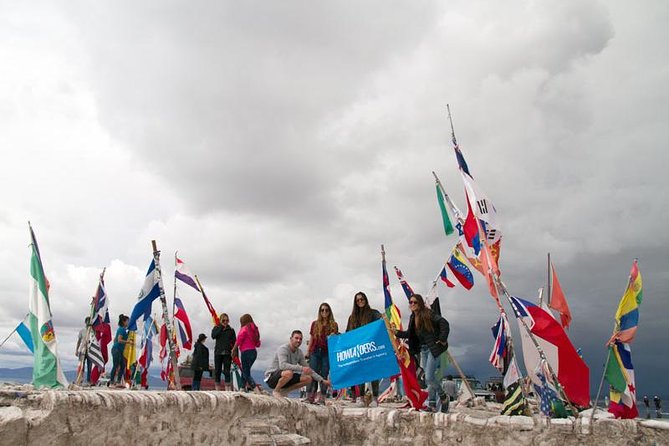
The route continues to the Dakar Sculpture and the Island of Flags. These are more constructed attractions than natural ones, but they mark the cultural and tourism side of the salt flats. You also visit Colchani, where artisan shops offer souvenirs connected with the salt region.
Lunch in Colchani and the Train Cemetery
After two days of meals prepared on the road, day three includes a sit-down restaurant in Colchani. That small comfort feels well timed. The tour includes lunch, but restaurant meals and portable meals are different experiences, especially after long hours in the 4×4.
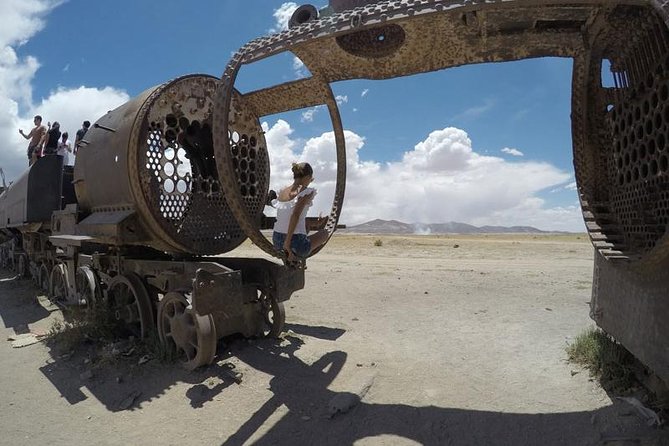
The final stop is the Train Cemetery outside Uyuni. Rusting railway carriages and engines sit in the open, remnants of an earlier period of Bolivian development. It is a stark sight, with the old machinery contrasting against the empty surroundings.
You then return to Villa Mar, the same accommodation area used on the first night. Repeating the overnight location keeps the route simpler, though it also means the tour does not follow a completely new path each evening.
Day four: the long return to San Pedro
The final day starts at 5:00 AM with breakfast in the dining room. You then travel for roughly four hours toward the Bolivia-Chile border, complete the crossing, and board the private shuttle back to San Pedro de Atacama.
Arrival is expected around 1:00 PM. That makes this a useful return time if you are continuing your Chile itinerary later the same day, though border procedures can affect the exact schedule. Keep your important documents accessible, and do not plan an airport connection or tight reservation without allowing extra time.
Round-trip transfers from your San Pedro accommodation are included. The pickup point is practical, but the operator sends the guide’s contact details within 48 hours of confirmation, subject to availability. Use that contact to coordinate the exact pickup details.
What the $325 price really covers
At $325 per person, the price is strong for a four-day cross-border route that includes transport, three breakfasts, three lunches, three dinners, and hostel lodging. You are also paying for the organization required to move between Chile, Bolivia, the border, multiple vehicles, and remote stops.
The price is not all-inclusive. You need to budget for:
- Bolivian border tax, when applicable
- Eduardo Avaroa National Reserve entrance
- Incahuasi Island admission
- Polques Hot Springs admission
The amount of these extra fees is not provided here, so ask for the current total before departure. That is the cleanest way to compare this option with a higher-priced tour.
The group limit of 12 helps protect the value. You are not booking a private trip, but the small-group format is more manageable than a large coach. Group discounts are offered, which may make this a practical choice for friends or families traveling together.
Guides, language, and the human side of the trip
A Spanish-speaking driver-guide leads the route. That is important because the driver is not only handling transport. The driver also helps coordinate border procedures, meals, timing, photographs, and stops in a region where services are limited.
English-language support is not stated as part of the tour. If you do not speak Spanish, clarify how communication will work before booking. One disappointing experience specifically pointed to the need for Spanish, while other accounts praised the drivers for being punctual, careful, attentive, and respectful of individual needs.
Names connected with especially warm service include Guilder, Raul, and Walder. You cannot assume one of them will be assigned to your departure, but their names are useful if the operator gives you a choice or confirms your guide in advance.
The food also receives strong praise. Expect varied, well-served meals rather than a need to carry four days of provisions. Still, tell the operator about dietary needs before the trip because no special meal policy is provided.
Altitude, cold, and the physical demands
Altitude is the biggest practical issue. The route crosses high Andean terrain, and the first day includes long drives, walking around lagoons, geothermal stops, and the Red Lagoon. A French-speaking participant found the first day especially hard because the effects of altitude were not expected.
I would not book this as a gentle introduction to Bolivia. Wear warm layers, take short walks at an easy pace, and keep water close. The schedule gives you time at each major stop, but it does not remove the strain of altitude, cold, early mornings, or rough roads.
The physical demands are not presented as a barrier for most people. The activity states that most people can participate. Even so, that general statement should not replace an honest assessment of your own health and comfort at high altitude.
Who should book this four-day crossing?
I would recommend it to you if you want a well-organized route from San Pedro to Uyuni and value seeing the highlands before reaching the salt. It suits photographers, first-time visitors to the region, and anyone who wants meals and lodging arranged in advance.
It is also a good fit if you want an authentic road journey rather than a single-day salt-flat visit. The hot spring, geysers, flamingos, wetlands, salt hotel, and train cemetery give the trip much more range.
I would hesitate if you need reliable English guiding, dislike shared hostel accommodation, struggle with early mornings, or want a slow and comfortable holiday. The private-room option improves the nights, but it does not change the long hours in the 4×4 or the basic nature of the route.
The cancellation policy allows a full refund if you cancel at least three full days before the local start time. Changes or cancellations inside that window are not refunded or accepted.
Should you book it?
Book this tour if the full Andean route appeals to you more than comfort does. For $325, the inclusion of transport, meals, accommodation, and a small-group 4×4 makes it a solid value, provided you add the border, park, hot spring, and Incahuasi fees to your budget.
Before booking, confirm three things: the language used by your driver, the private-room availability, and the exact extra entrance costs. If you prepare for altitude and cold, this four-day crossing offers far more than a quick visit to a famous salt flat.
FAQ
How long is the Uyuni Salt Flats tour from San Pedro de Atacama?
The tour lasts approximately four days. You leave San Pedro at about 7:00 AM on day one and are expected back around 1:00 PM on day four.
Is hotel pickup included in San Pedro de Atacama?
Yes. Round-trip transfers from your San Pedro accommodation are included. The guide’s contact details are sent after confirmation so you can coordinate the pickup.
What type of vehicle is used?
After crossing the border, you travel in a seven-seater 4×4 vehicle. The maximum group size for the activity is 12 people.
Is accommodation included?
Yes. Hostel accommodation is included. The options are a private room or shared dormitory, subject to availability. The itinerary also includes a night in a salt hotel with private rooms.
Are meals included?
Yes. The tour includes three breakfasts, three lunches, and three dinners.
Are entrance fees included?
Not all of them. Incahuasi Island, the Polques Hot Springs, and national park entry are not included. A Bolivian border tax may also apply.
What language does the guide speak?
The driver-guide speaks Spanish. English-language guiding is not specified, so ask about communication before booking if you do not speak Spanish.
Just added around San Pedro de Atacama
- Atacama Desert and Magic Bus Visit★ 4.8 · 15 reviews
- Vallecito★ 4.7 · 13 reviews
- San Pedro de Atacama: Valle de la luna★ 3.0 · 3 reviews
- Valle de la Luna: A Moon-Like Escape in Atacama★ 5.0 · 3 reviews
- Valley of the moon★ 5.0 · 50 reviews
- San Pedro de Atacama: Half day Valle de la Luna, Afternoon Tour★ 4.5 · 52 reviews
- Piedras Rojas and Altiplanic Tour★ 4.5 · 38 reviews
- Moon Valley Tour from San Pedro de Atacama★ 4.0 · 59 reviews
Private, compared.

Private Transfer from Santiago Airport to Santiago
Read our review →
Private Tour: Viña del Mar and Valparaíso Tour with Wine Tasting in Casablanca Valley
Read our review →
Valparaiso and Viña del Mar Full-Day Private Guided Tour
Read our review →
Private Day Trip to Cajón del Maipo & El Yeso Dam from Santiago.
Read our review →
Private Transfer from Santiago Airport or Hotel to San Antonio Hotel or Port
Read our review →
Private Transfer from Santiago Hotel to SCL Airport
Read our review →Browse the lists this tour appears in