
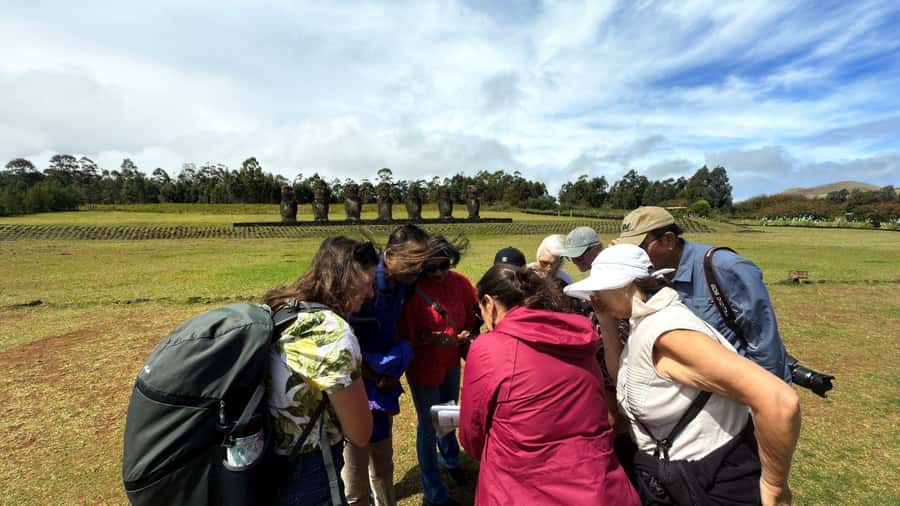
Reviewed · HALF-DAY
Easter Island: Half-Day Archaeology Tour
The striking mystery here is not only how Rapa Nui’s moai were carved and moved, but why seven of them at Ahu Akivi face the sea. Most moai turn their backs to the water, so this unusual group gives the half-day tour a strong centerpiece. You’ll also see the red-stone topknots called pukao at Puna Pau and a ceremonial platform far inland, away from the coast.
I like the small group of up to 15 people, which gives your English or Spanish-speaking guide room to explain the sites without turning every stop into a crowd scene. I also like the relaxed three-hour pace, hotel pickup, and drop-off in Hanga Roa. The main consideration is cost: the tour is $91 per person, but the separate Rapa Nui National Park entrance fee adds $100.
In This Review
- Key points to know before booking
- Why this three-hour tour works as an introduction to Rapa Nui
- Ahu Tahai and the solitary moai near Hanga Roa
- Puna Pau, where the red pukao were made
- Ahu Akivi and the seven ocean-facing moai
- Ahu Huri a Urenga and the island’s agricultural interior
- What the guide adds to the experience
- The real price: $191 before your own extras
- Who should book this half-day archaeology tour
- Should you book it?
- FAQ
- How long does the Easter Island Archaeology Tour last?
- What sites are included?
- Is the Rapa Nui National Park entrance fee included?
- Is hotel pickup provided?
- What languages are available?
- Can cruise ship passengers book this tour?
Key points to know before booking
- Seven moai face the ocean at Ahu Akivi: Their unusual position is linked to a story about seven explorers from Hiva, the Polynesian homeland.
- Puna Pau explains the red topknots: About 30 pukao can be found in or near the quarry where their red scoria was sourced.
- Ahu Tahai offers a different kind of moai view: One huge figure rises alone on its ceremonial platform.
- Ahu Huri a Urenga is inland: This platform connects the island’s ceremonial sites with an agricultural area.
- The tour takes three hours: It works well for a first look or for a tight schedule, but it is not a full survey of Easter Island.
- The national park fee is extra: Add $100 to the advertised $91 price when calculating the real cost.
Why this three-hour tour works as an introduction to Rapa Nui
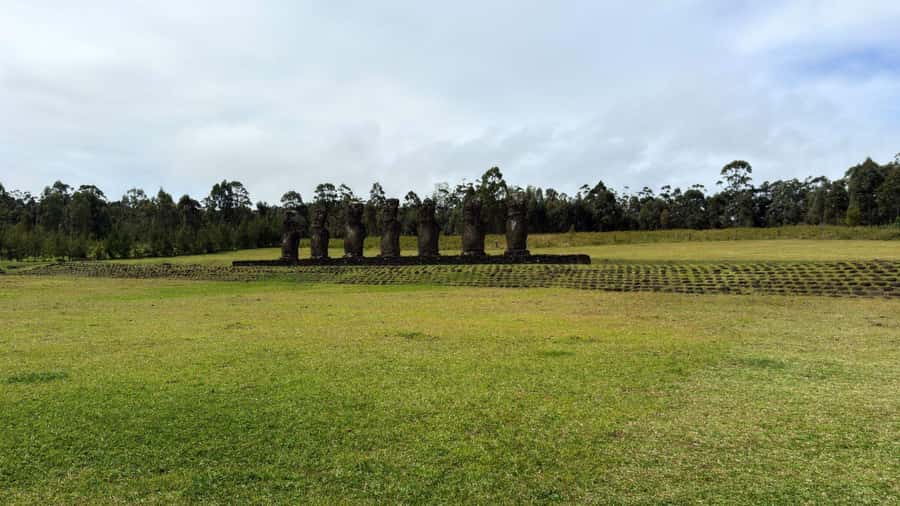
Easter Island can feel like a place you need to study before you can understand it. The moai are famous, but the important questions are less obvious. Who did they represent? Why were they placed on ahu, or ceremonial platforms? Why do most face inland, while the seven at Ahu Akivi look toward the ocean?
This tour gives you a useful first framework. Instead of visiting one isolated statue and moving on, you see several parts of the moai tradition: a coastal ceremonial site, a quarry for red topknots, a famous row of seven figures, and an inland platform tied to farming.
That variety matters. You begin to see that Rapa Nui is not simply an island covered with giant stone heads. The moai are connected to ancestry, tribal authority, ceremony, quarrying, agriculture, and the island’s wider Polynesian culture.
The schedule is short and focused. In three hours, you will not see every major site in Rapa Nui National Park, nor will you have time for a long, slow walk at each stop. But you get a sensible introduction without giving up an entire day.
The experience is especially useful if you are staying in Hanga Roa and want a guide to explain what you are seeing. The tour is also practical for people who prefer organized transport rather than arranging separate visits across the island.
A few more Hanga Roa trips to weigh up
- Ahu Vinapu, Rano Kao and Orongo City Half-Day Tour
★ 4.6 · 20 reviews - Santiago Half-Day Walking Tour with Hotel Pick up & Brunch
★ 4.7 · 148 reviews - Half-Day Small-Group Panoramic Santiago Tour
★ 4.0 · 89 reviews
Ahu Tahai and the solitary moai near Hanga Roa
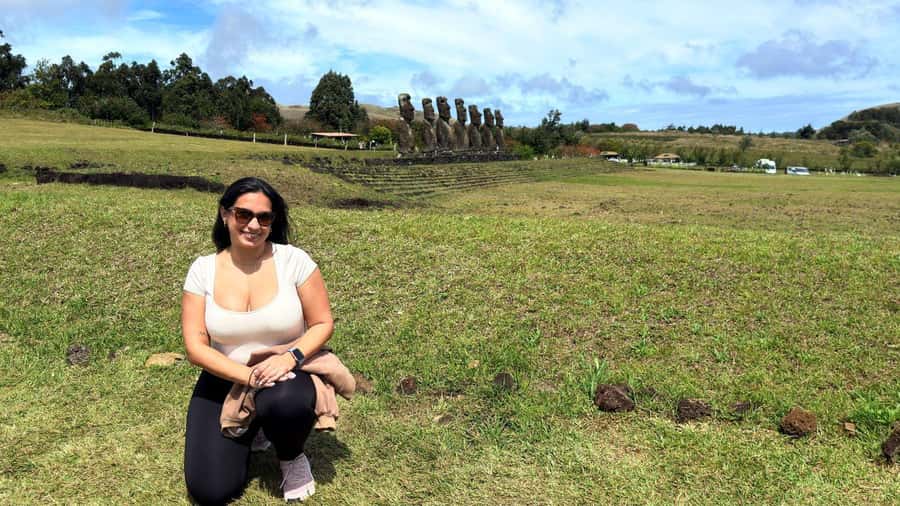
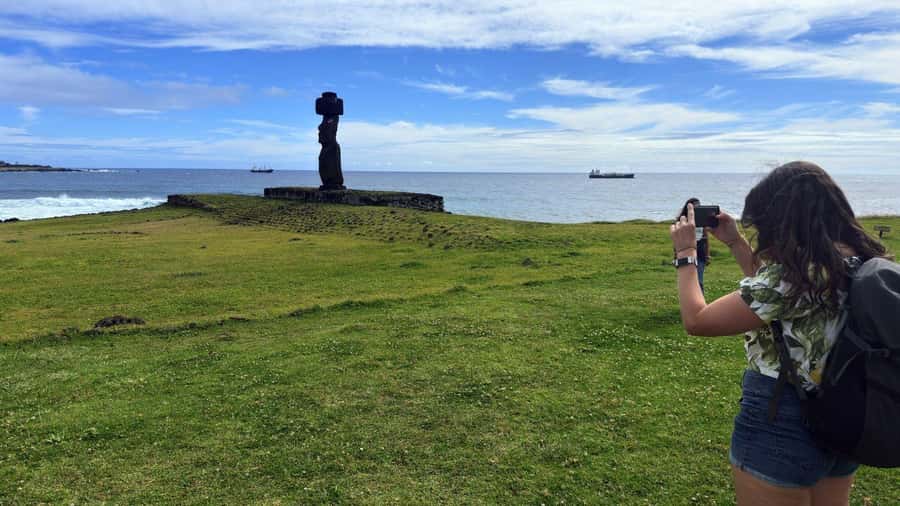
The first major stop is Ahu Tahai, a ceremonial platform near Hanga Roa. Here, you see a distinctive moai that rises alone, an imposing figure more than 13 feet tall.
Ahu Tahai helps you understand the basic relationship between a moai and its ahu. The platform is not just a pedestal. It is a ceremonial setting, and the figure represents more than a piece of carved volcanic stone. The statues are believed to embody the spirits of ancestors and important members of each tribe.
I like beginning here because the site gives you a clear visual lesson before the tour moves to more unusual places. You can take in the scale of the figure, notice how much work went into shaping solidified volcanic ash, and listen to your guide explain the role of ancestral statues in Rapa Nui culture.
Do not expect a long, private visit. This is a compact tour, and the time at each location is limited by the three-hour schedule. Still, Ahu Tahai is an efficient opening stop because you can see the moai clearly and quickly connect the statue with the platform beneath it.
Your guide’s explanation matters here. The best part of this experience is not merely reaching each site. It is having someone make sense of why a lone moai, an ahu, and the surrounding ceremonial setting belong together.
Puna Pau, where the red pukao were made
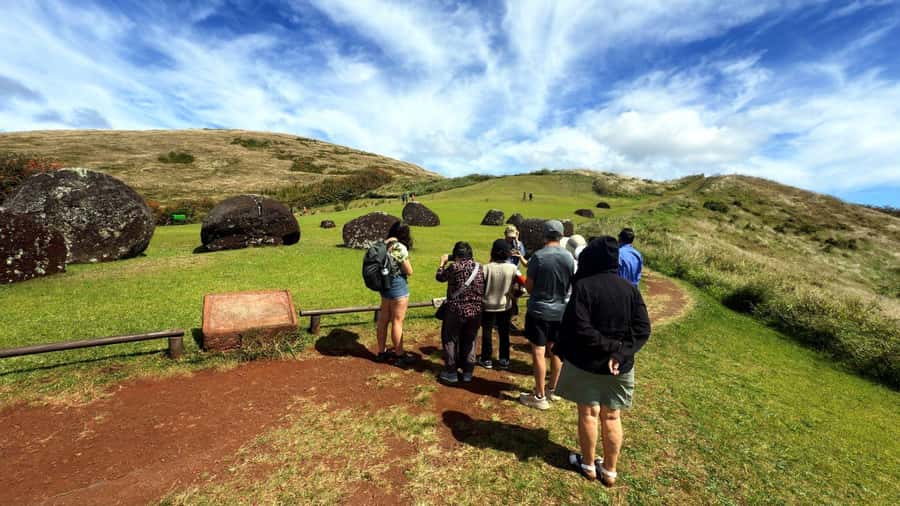
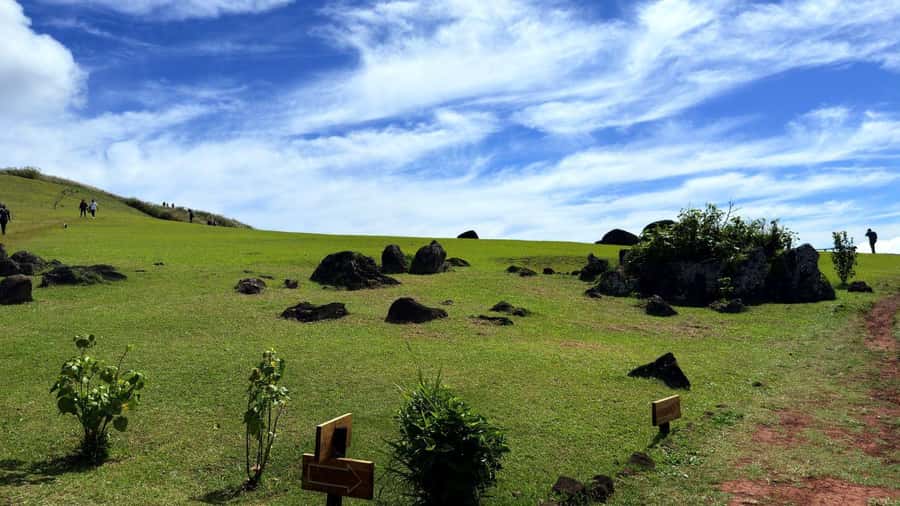
Next, you head to Puna Pau, the quarry associated with the red scoria topknots worn by some moai. These cylindrical stones are called pukao, and they give certain statues a very different appearance from those without them.
The red color is the immediate visual surprise. The moai were carved from solidified volcanic ash, while the pukao came from red scoria. About 30 pukao are located in or near the quarry, giving you a direct connection between the raw material and the finished objects seen elsewhere on the island.
The purpose of the topknots is not certain. One explanation is that they helped impress rival tribes. Your guide can place that idea alongside the larger story of status, competition, and ceremony without pretending every question about the moai has a settled answer.
That open-ended quality is part of the appeal. Rapa Nui history includes strong theories, but not every mystery has one proven solution. A good explanation should tell you what is known, what is likely, and what remains debated.
Puna Pau is also a reminder that the moai tradition required more than carving statues. Different parts of the figures came from different volcanic materials, and those materials had to be shaped and brought to ceremonial sites. Even on a short visit, you begin to see the scale of the work involved.
Wear comfortable shoes. The tour information specifically recommends them, and that is sensible for a quarry visit and outdoor archaeological sites. Large bags, luggage, baby strollers, alcohol, and drugs are not allowed, so bring only what you need for the outing.
Ahu Akivi and the seven ocean-facing moai
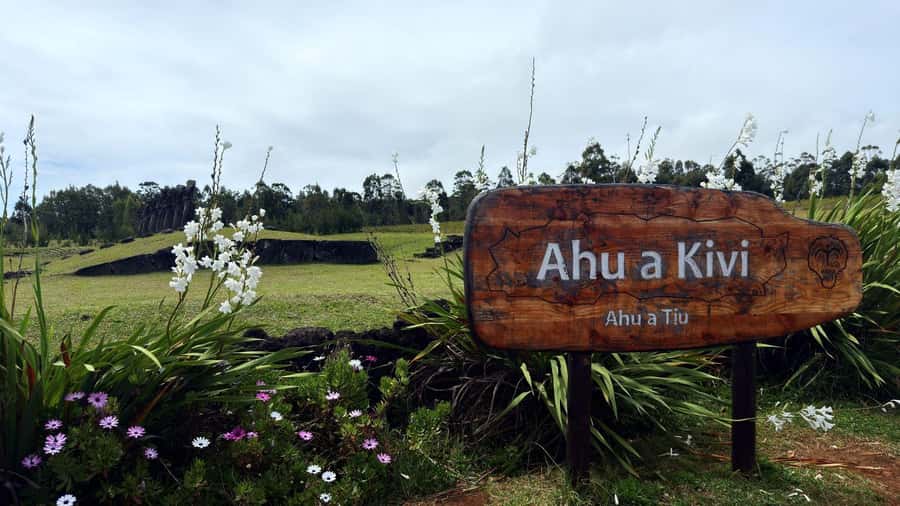
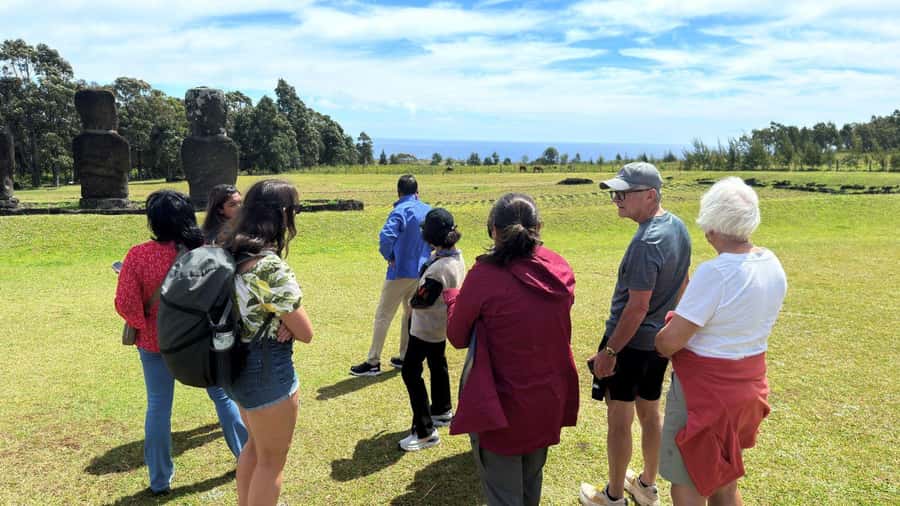
Ahu Akivi is the emotional center of the tour. Seven moai line the platform, each about 16 feet tall and weighing roughly 18 tons. Unlike most moai at coastal ahu, these figures face toward the ocean.
That orientation is what makes Ahu Akivi so memorable. The usual arrangement has the moai facing inland, with their backs toward the water. At Ahu Akivi, the direction changes the entire feeling of the site. You are not only looking at seven large statues. You are looking at a group with an unusual relationship to the sea and the wider Polynesian world.
One theory says the seven moai represent explorers sent by a chief from Hiva, the Polynesian homeland, to find Rapa Nui. Under that interpretation, their ocean-facing position points toward the direction from which they came.
Treat this as a theory, not a proven fact. That distinction is important at archaeological sites, especially ones surrounded by popular stories. The tour is strongest when it gives you the story and also leaves room for uncertainty.
The seven figures provide one of the clearest photo opportunities on this route, but do not reduce the stop to a photo pause. Look at the repeated forms, the different condition of the statues, and the way the line of figures changes when you move around the site. Your guide can help you notice details that are easy to miss when you are simply trying to fit all seven into a picture.
If you have only a few hours on Easter Island, Ahu Akivi is a strong reason to choose this tour. It combines scale, mystery, and a setting unlike the more familiar inland-facing arrangements.
Same long country, a very different day out:
- From Hanga Roa: Rapa Nui Culture Sightseeing Tour
★ 4.6 · 307 reviews - From Hanga Roa: Easter Island Highlights 2-Day Tour
★ 4.3 · 205 reviews - From Hanga Roa: Journey from Orongo to Ana Te Pahu
★ 4.3 · 75 reviews - Two days of Full Day Tour of Rapa Nui + Sunrise in Tongariki
★ 4.8 · 55 reviews
Ahu Huri a Urenga and the island’s agricultural interior
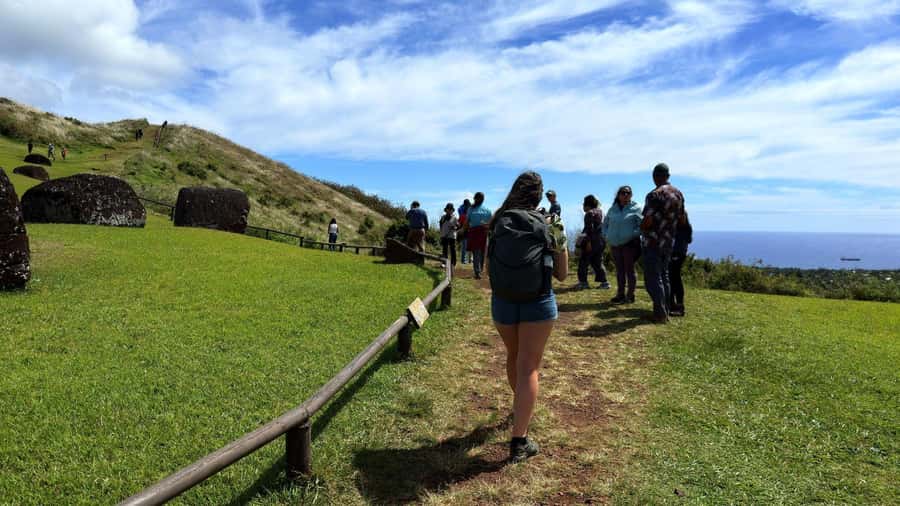
The final stop is Ahu Huri a Urenga, one of roughly 25 platforms located inland rather than along the coast. Its position corresponds to an agricultural area, which adds an important piece to the story of Rapa Nui.
It is easy to think of Easter Island’s history as a coastal story because so many well-known ahu are associated with the shoreline. Ahu Huri a Urenga widens that view. The island’s ceremonial life was connected to the interior, where food production and daily community life took place.
This stop may feel quieter and less immediately dramatic than Ahu Akivi. That is not a weakness. Its value comes from context. After seeing a coastal platform and a quarry, you finish by looking at how ceremonial traditions extended into the island’s farming areas.
The itinerary is well chosen for that reason. Each stop answers a different question:
- Ahu Tahai shows how a moai relates to its ceremonial platform.
- Puna Pau shows where the red pukao came from.
- Ahu Akivi presents the unusual ocean-facing figures.
- Ahu Huri a Urenga links ceremony with agriculture and the interior.
You then return to your Hanga Roa hotel, making the tour easy to fit around other plans.
What the guide adds to the experience
The tour is available in English and Spanish, with a live guide rather than only printed information. That is a real advantage at Rapa Nui’s archaeological sites, where a statue’s size is obvious but its meaning is not.
The guide’s job is to connect the physical remains with the larger cultural story. You want clear explanations of ahu, moai, pukao, and the theories surrounding Ahu Akivi. The strongest feedback about this experience points to an informative and personable guiding style, along with an easygoing pace.
That combination suits Easter Island. A rushed presentation filled with dates would miss the point, while a casual drive with no explanation would leave you looking at stones without understanding their place in Rapa Nui culture.
The group is limited to 15 people. That is not a private tour, but it is small enough to make questions practical and to keep the visit more manageable than a large coach outing. Hotel pickup also removes the need to organize transport to the first site.
Be in your hotel lobby 10 minutes before the scheduled pickup. The driver waits no more than five minutes after that time, so this is not the place for a relaxed last-minute breakfast.
The real price: $191 before your own extras
The advertised tour price is $91 per person. The Rapa Nui National Park entrance fee is not included and costs $100, bringing the known total to $191 per person before any other personal expenses.
That is a significant amount for a three-hour outing. You should judge the value based on what you need. If you want hotel transport, a guide in your chosen language, and a compact route through four important archaeological locations, the package is convenient.
If you already have reliable transport and plan to visit the sites independently, the added cost may be harder to justify. The tour does not include a full-day circuit, meals, or the national park admission, so it is not designed as an all-inclusive day of sightseeing.
For a first introduction, I think the value comes from the interpretation and the efficient route. A guide helps you understand why Ahu Akivi is unusual, how Puna Pau relates to the pukao, and why an inland ahu matters. Those connections are difficult to get from a quick look at a map.
The flexible booking terms also reduce some risk. You can cancel up to 24 hours in advance for a full refund, and you can reserve now and pay later. Starting times vary, so check availability before building the rest of your day around it.
Who should book this half-day archaeology tour
I would recommend it to you if you:
- Have about three hours available in Hanga Roa.
- Want to see several important moai sites without arranging your own transport.
- Prefer a small group rather than a large coach.
- Want explanations in English or Spanish.
- Are especially interested in the mystery of Ahu Akivi and the practical story of Puna Pau.
- Need a straightforward introduction before exploring more of Rapa Nui on your own.
It is less suitable if you want a full-day archaeological program or extended time at every site. The short duration keeps the outing manageable, but it also means each stop receives a limited share of your attention.
The experience is not suitable for wheelchair users, and it is not intended for cruise ship passengers. Pickup is for people staying at Easter Island hotels. Cruise passengers should not book this tour on the assumption that hotel pickup will work for them.
Should you book it?
Book this tour if you want a well-organized first look at Rapa Nui’s moai and prefer a guide to explain the stories behind the stones. Ahu Akivi alone gives the outing a compelling centerpiece, while Puna Pau and Ahu Huri a Urenga add useful context.
Think carefully about the extra $100 park fee. At a total of $191 per person, this is not a bargain introduction, but it is a practical choice for a small group, hotel transport, and a focused route through four distinct archaeological settings.
If your schedule is tight, this tour makes sense. If you have a full day and independent transport, you may want a longer visit that covers more of Rapa Nui National Park.
FAQ
How long does the Easter Island Archaeology Tour last?
The tour lasts three hours. Starting times vary, so check availability when booking.
What sites are included?
The route includes Ahu Tahai, Puna Pau Quarry, Ahu Akivi, and Ahu Huri a Urenga. The tour also takes place within Rapa Nui National Park.
Is the Rapa Nui National Park entrance fee included?
No. The park entrance fee costs USD 100 per person and must be paid separately.
Is hotel pickup provided?
Yes. Pickup and drop-off are included for Easter Island hotels. Wait in the hotel lobby 10 minutes before the scheduled pickup time. Drivers wait no more than five minutes after pickup time.
What languages are available?
The live guide speaks English or Spanish.
Can cruise ship passengers book this tour?
No. The tour is only considered for passengers staying in hotels and is not suitable for cruise ship guests.
Just added around Hanga Roa
- Volcanic Refuges: Excursion to Underground Civilization★ 4.7 · 8 reviews
- Sunrise Tongariki: Sunrise at Tongariki Park Private Tour★ 4.5 · 47 reviews
- Rapa Nui: Polynesian Massage★ 4.8 · 5 reviews
- Rapa Nui Highlights Program: 3 incredible tours to discover!★ 4.8 · 18 reviews
- Rapa Nui: 3 Excursions with Hotel Transfers★ 4.3 · 6 reviews
- Ahu Vinapu, Rano Kao and Orongo City Half-Day Tour★ 4.6 · 20 reviews
- Hanga Roa: Full Day Moai and Mistery★ 4.4 · 22 reviews
- Easter Island: Tropical Diving★ 4.8 · 13 reviews
Half-Day, compared.

Santiago Half-Day Walking Tour with Hotel Pick up & Brunch
Read our review →
Ahu Vinapu, Rano Kao and Orongo City Half-Day Tour
Read our review →


Browse the lists this tour appears in